
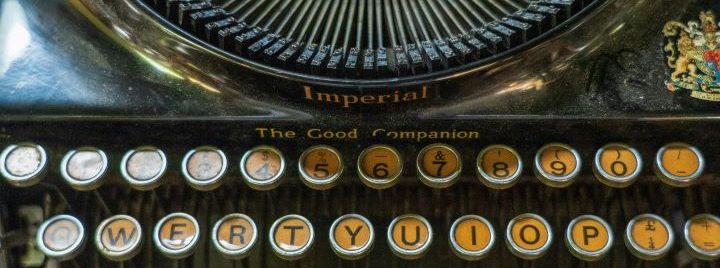
On a sunny late spring morning in what he could only assume was June, approximately ten years after the world had ended, Liam found a strange machine in the rubble-filled ditch behind the charred frame of a house.
It was rolled up within barbed wire and fenceposts like a set of gruesome wood and wire entrails, gently embracing a spiny, alien metal heart. It hardly looked real, and he couldn’t fathom what it could even be for. But he felt himself drawn to it somehow, like a magnet to metal. Brook always joked that he was like a magpie, that he had an eye for the shiny things. That was why they sent him out to do the scavenging runs. That, and the fact that he was too young to take guard duty.
The machine itself was an odd thing, all rusted spindly spikes and odd metal circles, a heavy frame and a boxy shape. But the things that really caught his eye were the letters.
Sam had insisted that he learn his letters, despite his protests. She had taken on the role of his teacher when he was younger, after Mom had gone, and she hadn’t taken no for an answer, as much as he whined that he wanted to be out hunting with Dale or fixing fences with Nina. Sam was insistent that way: she was a big, hard woman who took no arguments on the things that mattered. He was learning to read, and that was that. She had taught him each letter, how to string them together into words, what sounds they made. They didn’t always make the same sounds, which Liam thought was stupid, but he didn’t come up with the letters, someone else had, and apparently they wanted to make things harder for everyone. Of course, Sam didn’t have any paper, at least none that she was willing to waste on a wild-haired little boy with legs too long for his body and a constant nervous bounce in his knee. So she took him out to the dirt lot, under where they hung their laundry to dry in the thick Chinook winds, and they drew their letters together in the packed earth with sticks.
Sam had taken her thick, steady branch and traced his name in the dirt. LIAM. Liam. She made him sound out all the parts, slow and deliberate. Then, she made him copy the letters. It had taken him weeks to start really writing, even the simple sentences. Despite his love of it, language had never come easy to him, and Mom had always joked about how it took him longer than most kids to even start talking. Once he had, though, it was all full sentences, as if some dam of silence had broken and a linguistic lake was no longer restrained, a flood of language spilling over onto everything around. He used to speak in his sleep when he was young, quiet murmurs that babbled like the trickle of a creek even when the dam had long since broken.
Still, the writing of it took longer than the speaking, and it was a long time before Liam felt brave enough to write without Sam’s gentle corrections. The first time he wrote on his own, it was on a hunting trip with Brook. He hadn’t been allowed to hold the gun yet: he was too young, and ammunition had been too scarce to allow him any target practice. The idea of using a gun to hunt seemed comical to him now: The last five boxes of ammunition were in a small drawer in the cabin, with the gun mounted above the door for emergencies. A gun was more a decoration than a weapon. Not a thing to hunt with.
But back when the gun had been for hunting and Brook hadn’t been afraid to use it, he had gone with her into the mountains, taken his small pocketknife, and carved his name into a half-dead tree.
Three words.
LIAM WAS HERE.
A few years later, when he had come by the same tree, the name had still been there. It was different then, more like a healed scar, something for the tree to grow around.
It comforted him, somehow, the idea that his name could stay. That someone passing through the area would see it and know that he had been alive. That he had been real and tangible and he had left his name in the world, some evidence of his existence.
He had seen graffiti in the cities when they had gone on scavenging trips, paint dripping in harsh letters declaring to an uncaring universe that I WAS HERE. He hadn’t understood it until that moment, though. He hadn’t understood the urge to leave something behind, like a message sent through a time machine, the letters of people long gone singing into the future and reminding them that they were not the first to reach a place. That they were not alone in this world.
He had understood the point of letters then, though he would never admit this fact to Sam. And he was grateful to her for teaching them to him, though he would have been even more hesitant to admit that. He knew the way she would smile, the cadence of her I told you so laugh. She would ruffle her callused hands through his hair, and he would flatten it down again. She would smile at him with that sadness and hope behind her eyes that he hated. It made him feel like a symbol, or a project of hers.
He didn’t want to be a sign of hope. He just wanted her to stop treating him like a baby.
But when his eyes skimmed over the ragged and rusty metal and stopped to rest on those small letters, each enclosed within a circle, he couldn’t help but look closer. He might not have understood the machine, but he understood letters. And he couldn’t help but feel drawn to them.
The pile of debris looked like it had been waterlogged, and it had definitely been trapped under the snow for at least one winter. Unidentifiable scraps of metal, broken wood fragments, plant debris, and much more was wrapped around the machine, holding tightly to it like grasping hands. He squatted down to get a better angle, resting on the balls of his feet and inspecting it. Brook would make fun of him if she saw him like this. She’d call him her magpie again, perched on the debris, cocking his head to inspect his treasure.
His pocketknife couldn’t cut the barbed wire, so he had to attempt to pull it to the side. It took a few minutes to maneuver the machine out from the man-made and storm-shaped tendrils of debris, but he eventually managed it, only breaking one of the odd rusted spines on the machine in the process. He put the spine into his pocket, just in case. Sam used to warn him about rusty metal, and he felt a slight twinge
of relief that she wasn’t here to criticize him. He didn’t even remember why she said it was bad. Maybe it had a disease or something? Liam wasn’t worried. Rusty metal had never made him sick.
Sam was always overreacting like that. She was always telling stories of the old days, before the world ended. Of course, she never said that. Brook was the one who called it the end of the world, and Sam and Dale would always give her those mean looks, like she’d said something rude.
Of course, Brook was an adult, so they couldn’t tell her what to do. But they could tell Liam, and so he wasn’t allowed to call it the end of the world. At least, not in front of Sam and Dale. But Sam was always telling him about how things used to be, about how everyone got sick and how there wasn’t enough water for everyone and there were too many forest fires because of how hot everything was, and how everyone was mad at each other for reasons Liam still didn’t quite understand. She was always warning him about things like rusty metal or heights or the sickness that the odd deer had that made them stagger drooling and whining into the compound and made it so you weren’t allowed to eat them.
Nina told him that it was because Sam and Dale’s son had died on the day the world ended, and she wanted to take care of someone.
Liam just wished she would pick someone else to be worried about. He was doing just fine.
He pulled the machine from the wreckage at last, the thick bunches of grass reluctantly releasing it with a sudden jerk and causing him to stumble a few steps backwards. He inspected his prize, a rusty mechanical package that revealed no more secrets to him within his hands than it had in the garbage pile. A series of circles with letters inside of them were raised up on pegs within the machine, and small rusted spines like the tines of a fork stuck out of the top. Two small, slightly curved metal disks sat on either side of the metal spines, and there was a small latch at the bottom, as though there once had been a cover for the odd machine.
The underside was just as baffling as the top. The rusted metal was remarkably whole, making the contraption resemble a box even more closely. A box of letters on sticks and odd pronged spikes. What was this thing made for?
He checked his backpack, which was already crowded with a selection of scavenged items. A coil of unrusted wire, which would be perfect for patching up the fence. A red jug that smelled weird but could probably be cleaned up to catch rainwater. And best of all, an only slightly tattered sleeping bag, found in a shed that had been nearly cleared out, excepting a small chest low to the ground. There were benefits to being smaller than everyone else.
He had enough for the day, and nobody would be disappointed if he headed home now. Plus, he wanted to show off his odd machine. Maybe someone in the compound would know what it was. Nina was good with technology like that: maybe it was some kind of radio attachment that she could use when she did her broadcasts looking for people nearby.
Heart racing at the possibilities of his discovery, Liam packed up his bag again and headed home towards the compound.
Liam didn’t remember the day that the world ended. He had been four at the time, which he thought was more than old enough to start remembering things, but it was as if a big blank spot hung in his mind, thick and fuzzy like the static on Nina’s radio. Mom had never talked about what those days were like, before they found Sam and Dale and their little mountain compound. When he used to ask her, she would get this sad and distant look on her face, like she was seeing somewhere Liam couldn’t. Like she was looking through walls. She had stared like that more and more in the days before she died.
Liam didn’t remember the name for the type of cancer Dale thought Mom had had. All he knew is that she got all thin, except for her stomach, which was lumpy and sore. Her skin and eyes turned a little bit yellow, and she stopped eating. She cried all the time, too. Liam used to sit by her bed and let her hold his hand.
Eric had once told him that they used to have ways to help with cancer, back before the world ended. He said that sometimes people got better. But they didn’t have any machines or chemicals to stop the cancer here, not anymore. So Liam had to watch Mom get smaller and curl in on herself like a dead bug at the end, weeping softly but telling him how brave he was, how he had always been so brave, and how he was going to be okay because he had people to take care of him.
He didn’t like remembering Mom the way she looked at the end. He liked to remember her when she had been healthy, the way she shone in his first memories, when they finally made it to the compound and found a home. She had been big and strong then, tall and smiling with long muddy-blonde hair that nearly reached her waist.
Dale always said that he had his Mom’s hair, and her warm brown eyes. But when Liam looked into their mirror at himself, he never saw his mother looking back. Only a too-small boy in too-big clothes, with tousled and dirty hair, eyes too big for his face, and a scar on his chin from where he had tripped while running and fallen into the corner of a table.
He had always been a clumsy kid. But he was sure of his footsteps now as he jogged through the forest, retracing the path to the compound.
The compound consisted of a farmhouse, an old barn that had been renovated into more living quarters on the upper floors, and a large garden, all fenced in by chain link. Sam and Dale called themselves “preppers”, which meant that they had built their place to keep them safe even before the world ended. Liam couldn’t understand why anyone wouldn’t build their houses like that, even before. The idea of making a house without a fence was ridiculous, anyways.
Unlocking the gate with his key, Liam slipped through before closing the gate behind him. Nina was up on the roof working on her radio to communicate with the other people that might be out there: the nice ones, at least. She really thought that she was getting close this time. Beside her, Eric was rummaging in his toolbox.
Dale had married the two of them a few weeks ago, officiating a ceremony full of laughter and missteps. They didn’t have decorations, but Sam had cut pine boughs and created a bower, and they were married in the garden beside the peas and tomatoes and the dill that spread everywhere no matter how they weeded it.
Liam had gotten to be the best man.
Nina and Eric had met after the world ended, and now here they were. He could hear Eric arguing with her, worrying about her slipping and hurting the baby.
He’s just like Sam, Liam thought. So worried about taking care of everyone.
Sam herself was nowhere to be seen. Liam thought that she might have been on dinner duty tonight, in which case she was probably cooking on the woodstove upstairs in the farmhouse. Sure enough, a telltale trace of smoke snuck up from the chimney of the house and drew itself along the skyline in a lazy arch.
He entered the farmhouse through the front door, stomping off the mud and kicking his boots off as he hurried into the living room.
Brook looked up from sewing a rip in Nina’s jeans, her face breaking into a smile that distended the scar on her cheek. “Liam! Thank God you’re here, I was getting a little stir-crazy. Find anything interesting?”
Her eyes traveled down to the machine clutched in his hands, then widened in curiosity. “Is that a typewriter?”
Liam shrugged nervously. “I don’t know what that is. It just looked interesting.”
She stood up, bracing her crutch under her arm and making her way to his side. She leaned over slightly to examine the object.
“Holy shit, it is!” She paused. “Sorry, kid. Holy… crap?”
“I heard that,” Dale said from the other room, though there was no threat in his voice. Liam saw through the cracked door that he was shaving off strips of willow bark to dry for the medicine stores.
Brook laughed. “Sorry again, kid. Old habits die hard. I didn’t spend much time around kids before you. And I guess I’ll have to get even better at it, with Eric and Nina’s little guy on the way.”
Though he balked at still being referred to as a kid, Liam couldn’t help but savor the single offered detail of her old life.
Brook rarely talked about her life before she came to the compound. Whenever Liam brought it up, she got those wide eyes like Mom used to, the eyes that looked somewhere else. Brook had joined the group after her and Mom did, but he didn’t remember what exactly had happened. He remembered shouting, that she had been scared and angry. She was rail-thin, in stained and torn clothes, holding a dirty knife in her hand and staring with wild eyes. There had been an oddly shaped pack on her back, giving her the hunchbacked silhouette of a monster in the twilight, and Liam had watched her from the farmhouse window with fear. She had been demanding something of Dale, asking him to drop his gun, and he refused. He remembered the look in her wide dark eyes, all fear and anger. There had been an injury on her cheek, a long slash mark that was situated somewhere between a wound and a scar, still healing.
She had been scared even when she joined, after Sam patched her up and offered her a spot in the compound. It took her a long time before she learned that she didn’t have to sit with her back to the wall, that she could laugh with abandon and not have to keep a stash of food under her bed in case of a famine. Sam had always been stern with her, firm yet kind. Brook was barely a teenager then, but already so angry, and so afraid. It took her years to learn to breathe easy.
The pack on her back had been a guitar case, one which Brook refused to open. She never told anyone who the guitar had belonged to, though the name Sarah was etched into the case along with a
series of stickers, many of which Liam didn’t understand. Nina told him they were band names. The case remained under Brook’s assigned cot, and it was a mystery to the compound whether there was even an instrument inside of it anymore.
But slowly, painstakingly, Brook had begun to open up. She had begun to laugh, to make jokes, to weed in the garden without being asked. She taught Liam how to tie knots and how to navigate by the stars. She played pranks on Dale.
And then, one day last year. Brook had taken the gun, which still had ammunition, the one-man tent and the sleeping bag, and food for a few days. She had gone into the woods to hunt, with a promise to return. Dale had planned to go with her, but he had unexpectedly rolled his ankle and couldn’t walk. Eric and Nina were still new to the compound, and they had come from the city. Liam was too young, and Sam didn’t trust the couple to not steal food and take off, so it was down to Brook to bring back next month’s meat.
She had gone into the woods with a smile on her face.
Three days later, Eric had been on a routine patrol of the paths around the compound and found Brook unconscious and bleeding out into the moss, her left leg a mangled mess and her clothes soaked in blood.
They had followed her, she said. She had seen two lone hikers far off in the distance and had been too nervous to make contact. She had cut back to avoid them, not wanting to risk danger, and begun to head back towards the compound. And that night, they had taken a knife to her tent and dragged her kicking and screaming out of it.
Of course, they hadn’t known that she had a gun with ammunition, a rarity these days.
She had grabbed the gun, but both men had knives, and they tried to pin her down but she was a good shot with a rifle, and then—
And then Liam had been ushered from the room by Dale, indignant at missing the rest of the story.
Later, Liam had snuck up to the cracked door to the room they called the infirmary, where Brook’s muffled screams of pain echoed as Sam tried her best to treat her leg. There had been small pieces of bone, tattered flaps of deep brown skin wrapped around twisted sinews, and blood, so much blood.
He hadn’t thrown up. The image hadn’t felt real. That couldn’t really have been Brook’s leg. People couldn’t be that ugly on the inside.
Sam did her best, but nobody could have saved the leg. Brook had walked too far on it, and the knife had dug too deep.
Nobody talked about what had happened to the two men. Sam and Eric went out on a trip a few days later, hiking out the same way, and came back with the gun, Brook’s bags and what was left of the tent. They never mentioned the men, but Dale stayed at Brook’s side for an entire week afterwards, offering a hand to squeeze as she faded in and out of consciousness. She yelled in her sleep, obscenities and curses, pleas for help and threats.
Liam wanted to spend those nights curled up in his mother’s bed, but she wasn’t there anymore. So he was brave, and he tried to ignore the sound. He tried to pretend that she was alright, that she would be okay.
She was okay, eventually. Or at least, most of her was. Her left leg below the calf was gone, the flesh twisted and gnarled from infection and messy stitchwork. But she was alive.
Three things changed from that point on. First, no one was allowed to go more than half an hour’s walk from the compound without a buddy or special permission from Dale and Sam. Second, Dale spent a
month making a prosthetic wooden leg for Brook, and though Liam knew it hurt her to wear, she learned to walk again, when she wasn’t using the wheelchair he had made for her.
But third, and perhaps most importantly for the compound, while she was bedridden, Brook opened the case and started to play the guitar again.
The guitar was a beautiful thing of dark wood, kept in perfect condition with the strings exactly tuned. And Brook held it with a gentleness that she showed very few things in her life, deft long fingers moving to shape the chords around the neck of the guitar, flowing like water from note to note. Her voice was soft, raspy and low when she sang.
It was beautiful.
It became a tradition, that every night they would gather around Brook’s bed and listen to her play as the twilight settled upon the house like brooding bird gathering the trees beneath its wings. Every evening, as the sun kissed pink and then purple light across the horizon and night fell, the steady strum and rhythm of the guitar sent it off in style.
The guitar leaned against the wall now, beside Brook’s chair. The late beams of sunlight stretched across the case like a lazy cat, illuminating the etched name on the case, a stranger that Liam would never meet.
He wondered if Sarah was the one who had taught Brook how to play like that.
“Where did you find a typewriter?” Brook asked incredulously, bringing him back to the moment.
“It was in the junkpile down by the old town,” Liam said. “But what is it?”
“I always forget that you don’t know stuff like this, little guy,” she said with a smile, ruffling Liam’s hair affectionately.
Why did everyone always insist on doing that to him?
“Did you say that he found a typewriter?” Dale’s bearded face peered around the corner; his bark peeling abandoned in favor of curiosity.
“Yeah, check it out,” Brook was beaming, an expression that had taken a long time to return. He was glad to see it now, though still baffled at why exactly a machine like this would inspire much joy. Could you use it to send SOS messages? Did it run on electricity from the solar panels?
Dale came to inspect it as well, whistling in appreciation. “I haven’t seen one of these in ages.”
Brook pressed one of the letters, and it lowered with a loud scraping clack. He saw something inside the machine twitch in response to the button.
“Oh, it works!” she said incredulously. “I wasn’t expecting that, with the rust.”
“Can someone tell me what is is?” Liam snapped, losing his temper.
The adults paused, looking at one another in the condescending way they sometimes did before turning to him with apology in their eyes.
“I’m sorry, kiddo,” Dale said. “We just get excited seeing the old stuff, is all.” He elbowed Brook. “Because we’re the old stuff, eh?”
Brook elbowed him back, stabilizing herself with her crutch. “Speak for yourself.”
Liam glared at her until she turned back to him.
“Right, sorry.” Brook said. “Uh, it’s a typewriter. You press the buttons and then it writes things for you,” Brook picked up the typewriter, demonstrating. “You put a piece of paper and some ink in, and then it prints out the letters that you type. People used to write letters and books that way.”
Liam felt his heart leap. This was how people used to write, before. This was how they did it.
“It looks old, though,” Brook continued. “Not even ten years ago, hipster typewriter old, but older than that. This might be from when typewriters were actually in use, way back in the nineties or whatever.”
“More like the seventies or eighties.” Dale looked offended.
Liam couldn’t even imagine the seventies. Was Dale really that old?
“Wait,” he said slowly. “So it’s not tech from before?”
“It was old long before the world ended, buddy,” Brook said, looking at him with a sad sort of smile.
Dale glanced between Brook and Liam, looking like he wanted to correct her, but said nothing.
Brook corrected herself, almost out of habit now. “Sorry. Before things changed.”
Dale gave a subtle smile to her, one she echoed.
“We should show this to Nina,” Liam said, excitement rising. He could write letters and leave them at waypoints to communicate with anyone traveling through. He could use the writing machine to label all the pickling jars. He could write letters to Nina’s baby and the baby could read them when they grew up. “Nina will know how to get it working.”
Brook and Dale shared a glance between them that he couldn’t read. Was something wrong?
“What will I know?” Nina’s soft voice trickled in as the front door opened and she and Eric made their way inside.
“Nina!” Liam shouted. “I found a typewriter!”
Her and Eric’s faces lit up at the statement, and they rushed forwards to examine his find.
He held it up proudly, letting Nina inspect it. Her face seemed to fall slightly as she looked it over, though she still remained smiling. Eric rested his hand on her shoulder, leaning over to observe with equal interest.
“I was thinking that we could fix it up together.” The words spilled out of Liam’s lips, like another broken dam. A writing machine, and he had found it! This was the best day of his life.
Nina pursed her lips, furrowing her brows as she took the typewriter into her hands and turned it over. The rust left deep orange stains on the tan skin of her hands.
She looked up at Liam with an apologetic smile. “I’m so sorry, honey. I don’t think this is the kind of thing I can fix.”
His heart sank. “But it’s super useful! We can write each other notes and we can practice letters like old schools used to.”
“Believe me, if I could, I would,” Nina said softly, handing it back to him and dusting her hands off on her jeans. “But it’s been rusting for a long time. I don’t even know if all the buttons work. And we don’t have any ink or paper.”
“But we can try, right?” Liam said quietly, preparing himself for disappointment. “We can try to make it work?”
Nina paused for a moment before responding. “Yeah. We can try. It might not work, though.”
“I know. But I want to try. Please.”
She nodded. “We’ll do our best.”
Sam’s voice called down from the kitchen. “Everyone ready for dinner?”
Beginning their separate conversations, the adults began to trickle towards the kitchen, offering to carry plates and dishes to the table and chatting among themselves.
Eventually, Liam was left alone in the living room holding the rusty typewriter, trying to prevent the tears welling in his eyes from escaping. He really thought that he had found something useful this time.
“Liam, are you—” Sam paused at the top of the stairs, looking down at him. Catching sight of the tears in his eyes, she quickly descended the stairs and embraced him, holding the typewriter between them.
She pulled away, keeping her hands on his shoulders as she looked at him with worry in her eyes. “What happened? Are you alright?”
Liam nodded, afraid to speak with his throat so tight from tears. Eventually, he choked out an explanation. “I—I thought we could fix this typewriter I found and use it. But Nina think’s it’s too broken to fix.”
“Oh, kiddo,” Sam said, taking the typewriter from his hands and setting it down before hugging him again. “I don’t think it’s impossible to fix. Unlikely, maybe. But I’ve fixed plenty of impossible things in my day.”
“Really?” Liam said quietly, his face still buried in the crook of her arm.
“That’s what we do, Liam. We fix what we can fix. And almost everything can be fixed, even if it isn’t the same as it was before. Nina will do her best, and the rest of us will help out if we can. Don’t give up just yet.”
Liam could only sniffle, simultaneously wanting to leave her embrace and desperate to stay a little longer.
“Now come on,” Sam said, ruffling his hair with one hand. It took everything in him, but Liam didn’t protest. “Dinner’s getting cold.”
Dinner was a loud and messy affair, as usual. The motley collection of survivors laughed and shouted, trading jokes and stories about their days. Spring had come and gone with color in its wake, and the garden was alive with food enough for them to gorge themselves on.
Sated, they retired to the living room again, where the typewriter still kept its rusty vigil over them.
Brook took her guitar down from the wall and began to tune it, and the conversation slowly died down as the survivors hushed in anticipation.
And as the soft yet strong melody of Brook’s voice spun through the air and the earth spun onward through space, Liam watched the sun set with a rusty typewriter on his lap.
And he began to type.
Liam pushed each key deliberately, feeling the button depress with the quiet scrape of rust and aged mechanisms. The spines twitched with each press of the button, moving with no paper or ink to print with.
The machine would leave no record, no imprint upon the world. But he felt the motion deep within his bones, an assertion to the world that he was alive.
LIAM WAS HERE.