
August 2039
“What the hell is that?” asked Kyle, his voice muffled by his own shoulder. He could
almost taste the steroids pulsing through the bulging veins that stuffed his mouth as he struggled
to get out of the pretzel position that he fell into. One misplaced step found him intertwined with
the trash heap he was so carelessly gallivanting over.
“Kyle, where’d you go?” Craig called out, finally catching his breath from laughing so
hard at his friend’s misfortune. As he ran up to meet his fallen friend, he continued, “You just
disappeared there.”
“Shut up and help me up,” Kyle retorted, still face to face with the rusted phantom below.
With a grimace and a grunt, Craig hefted his friend out of the valley of debris (he could easily
bench four hundred pounds, and Kyle was only two-fifty), and they both turned to see the
imprint of Kyle’s sudden impact. His two hundred and fifty pounds of pure unnatural muscle
made a distinct impression on the landscape of twisted wire and tattered scraps of careless lives
before.
“Dude, check it out. I even dented that baseball bat,” marvelled Kyle.
“I think that was dented before you. But what the hell did your big ugly face do to
that…thing?” Two brass spindles framed a crooked iron smile, with some thirty odd arms of
keys jutting out the top with a chaos that gave the creature the composure of a ginger Einstein.
Some keys remained; Craig thought he could make out an “E” and a “K”, or was it an “X”? Most
of the others had fallen through the cracks of bent bike tires and old tree carcasses into some
deeper circle of hell, while their host remained in purgatory, a poor soul with too many teeth
punched out to speak; to call out for help. And so, the ghastly face stared up at the two friends,
more exposed to their eyes than to the elements that had slowly eaten it away. “It looks just like
you.”
“Shut up…” The two stared down at the beast in silence as the dusk descended into night,
the sky more blue than black, but sprinkled with satellites and the odd star. A shiver reawakened
Kyle, whether brought on by the chill of the sunless air or the sight before him, he did not know.
Either way, Kyle broke the silence with a whisper. “We should get out of here.”
Craig nodded, their late-summer adventure spoiled, and they turned back and began to
traverse the landfill they were trespassing on, careful lest they be forced to confront another
ghost.
March 1952
A wash of ombre light filled the room as the two Edison bulbs hummed to life, silent
music to the aging ears of Richard Cartwright. He enjoyed the dimness, the warmth of these
bulbs in his dark oak office, the musk of old books and cardigans almost visibly wafting in the
coiled rays of light. The room was but the preferred ambiance to the setting of his work, that old
mahogany desk with a brighter, new lamp on one corner and a picture of his wife and two young
boys on the other. Richard switched the lamp on with a little click at its head, and sat with two
little clicks at his knees, the leather of his wing-backed chair softly squeaking beneath him.
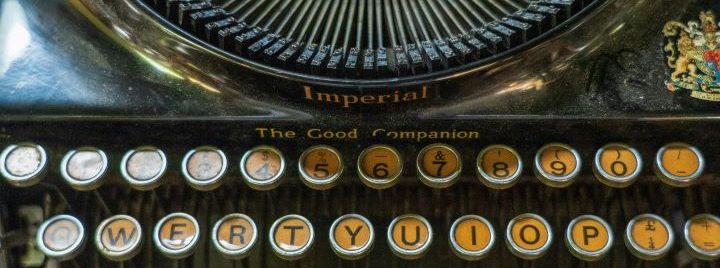
Centred on his desk was his prized possession, it’s thirty odd teeth smiling up at him. It’s jetblack
casing reflected the light directly onto the paper pressed within its upper lip.
With a yawn, Richard slowly reached his arms behind his back, pressing his knuckles
deep into the middle of his back and simultaneously cracking both. He leaned forward, arms
outstretched, and began the familiar dance of his fingers. Reaping only a faded, grey fruit, he
groaned and reached into the upper right drawer of his desk, returning to his beloved device with
a new double spool of ink. He caressed the temples of his friend, and with an outward and
upward motion popped the upper casing off. Resting it to his left, he withdrew the old, warn
ribbon and dropped it in the black wire trash bin at his right leg. Then, threading in the new life,
he began to hum “Yankee Doodle”, snapping the lid back on at the final note.
With a sigh and a stretch, he once again commenced his work, the virtuosic clicketyclack
of the keys playing their old familiar song. Surrounded by great works, his own on the
shelf to his right, and the works of “the many greats before”, as he would say, to the left, he
passed three, maybe four hours (he didn’t care) in the spell of his true companion. It was given to
him as a gift for his twenty-fifth birthday by his ever-encouraging parents. Both gone now, he
felt they lived still in the gift still before him, and every session was a happy reunion. Every great
book he wrote was written with it.
“Not every book I’ve written, mind you,” he’d joke to what few friends he had, “but
every great book.” Together, they wrote late into many a night, and this night would be
celebrated as they finished the next great Richard Cartwright novel. He knew he wouldn’t live
forever. But, like his parents, he hoped he might too be enshrined in his beautiful typewriter, at
least in memory, if not in spirit. He hoped.
June 2042
Riley felt on top of the world as she crested the peak of potential treasures. The mid-day
sun drew glistening beads of sweat across her forehead as she tied her violet hoodie around her
waist. Scouting the horizon, she was amazed by the tall grass percolating up through the debris
of domesticity. How resilient it must be, she thought, surviving through decades of dumping,
managing to grow in such a congestion of non-compostable crap. She imagined she was like that
grass, always managing to find the sun.
“This is dumb!” Kelsie interrupted. Still seeing sunshine, Riley insisted in her mind while
drawing a deep breath. Kelsie and Ryan crawled up behind her, both desperate for breath and
trying not to get a tetanus-assured scratch from the materials they were scaling.
“Isn’t this beautiful, though?” asked Riley, more as a plea.
“It’s a dump,” retorted Kelsie.
“Literally,” Ryan added as he straightened his back.
“Well, yeah,” Riley began, desperately, “but it’s also a well of possibility. We’re being
actual treasure hunters right now. Who knows what we’re gonna find.”
“I have a hunch we’re gonna find garbage,” groaned Ryan.
“Okay, but one man’s garbage is-”
“Don’t,” interrupted Kelsie. Riley sighed, her shoulders sinking a bit. I’m like the grass,
she reminded herself, returning to her optimistic posture.
“Well, with that attitude, I’m definitely gonna find something cool before you!” Riley
called out as she began to run down the mound. Kelsie and Ryan rolled their eyes at each other
and sauntered behind her. Riley had never been more alive. The breeze she made blew her hair
back, a golden river in the sunlight. Like a mountain goat, her eyes darted between finding her
next precarious footing and absorbing the iron and plastic wilderness around her. Eventually
overcome by the latter, a careless step brought her down, face first, with all the speed and
whimsy she brought with her. She gasped, “Oh my God!”
“Oh no, what happened?” Kelsie called out, now (finally) running to meet her friend.
“Did you get impaled?”
“No, look!” Riley responded, propping herself up and pointing down. As Kelsie and
Ryan made it within reach, she announced her triumphant find. “A typewriter.”
“A what?” Ryan asked, half earnestly and half testing Riley’s patience.
“Oh, come on. You know, a typewriter. Like what they used to write before computers.”
“Didn’t they use pencils to write before computers?”
Riley, her patience sufficiently tested, snapped, “They used them to type before
computers, smartass.”
With a bit of a grin, Ryan finally approached enough to see the ancient treasure. There
wasn’t much to see, however. The rust had passed the point of mere discoloration, with visible
holes speckled as much as little flecks of jet-black paint across the bent and beaten hull. The keys
appeared to be held together by the spiderwebs sprawling between them. There were no signs of
ink, no cartridge or ribbon, just two empty brass spindles like two sad eyes lamenting a long-past
better life.
“That piece of junk?” Ryan asked, dealing another blow to the poor trinket.
“It’s incredible!” Riley responded forcefully, desperate to defend what little dignity it had
left. “I’ve never seen one in person.”
“Do you think it still works?” asked Kelsie, finally joining the conversation with a
question not worthy of being a part of the conversation. It was met with the slow, synchronized
turn of both Riley and Ryan’s heads, a piercing glare in both their eyes. “Well, I don’t know,”
was Kelsie’s defence.
“Are we just gonna look at it?” Ryan asked in a tone that made Riley question why she
brought him along at all.
“We should take it to a museum,” Riley said, trying to maintain what little wonder
remained in the moment. “Help me grab it.”
“I’m not touching that,” blurted Kelsie. Riley turned to Ryan and was answered with a
vigorous shake of his head.
“Okay, fine!” Riley snapped, plunging her hands into the heart of the gravesite. As she
tenderly began to lift, she felt tension, something clinging to the artifact. She felt underneath to
find some wire wrapped around one of the feet. Blindly twisting around and around, she finally
felt her find become free and she brought it directly to her chest, an embrace the only natural
thing for her to do. She rose to her feet, and with the true defiance and optimism of the grass
around her said, “Come on. People are gonna love this.”
November 1966
Blake and Arnold Cartwright didn’t know how to grieve. When their mother died five
years ago, their father did enough grieving for all of them. He never wrote again. Now, at his
own passing, the world made up for the Cartwright boys’ incapacity for grief. They were
composed upon receiving the call: Blake, in the middle of an important meeting in New York,
and Arnold while still waking up from a nap in his New Mexico home. They were stoic at the
funeral, refusing to make a scene in front of the hundreds in attendance. And they were
completely emotionless, heartless even, as they settled their father’s estate. Each already blessed
with half their father’s wealth and royalties, they were eager to be rid of their father’s junk and
have the matter over and done with.
“Do you want his cardigans?” Blake asked his brother as they rifled through their father’s
oak-lined sanctuary.
“Nah,” Arnold answered, emptying the drawers of the desk.
“Me either. I’ll just chuck ‘em.” With that, Blake threw them over his shoulder into an
increasingly large pile of ill-fated treasure.
“What about the books?” Arnold asked, reaching around himself to crack his back and
knuckles together, a habit unknowingly inherited from his father. He might have rejected that
too, had he ever seen his father do it. “They ought to be worth a few bucks.”
“Yeah.” With that, they were stacked into boxes and added to the only other pile, the
estate sale pile. Never had the brothers considered creating a third pile, the one their father most
hoped would emerge: the keep pile. With little left to throw away, and even less to sell, the
brothers were tired and cranky and eager to be done with the day and the task at hand. They
couldn’t stand the dim lighting in the room as the sun made its way to the other side of the earth.
The smell was even more daunting. It smelled like their father, who was there no more, and this
confused the brothers. Arnold leaned against the desk, lurking over their final, tragic victim.
“What about this?” he groaned.
“No one’s going to buy that. Look at how worn out it is, you can’t even read most of the
letters.”
“Garbage it is, then.” And with that, it was over.
January 2055
“Home of the Last Typewriter” read the banner that was rapidly singed from the bottom
right corner up. The museum should have known better than to so boldly advertise something so
defiant. Museums weren’t safe. Libraries weren’t safe. Nowhere was safe. For the sake of “the
future”, the mob set fire to the past. Shattered windows reflected little tiny fires consuming
artifacts of glass, fabric, paper, metal, wood, and stone. The building was brick, but as the
wooden trusses at its heart became coal, the whole museum groaned; no, it wailed. It grieved.
And with a final haunting scream, two stories of suspended time collapsed into a single, shallow
grave. Nothing survived the fire. Not the two nighttime custodians, trapped in terror. Not the
museum, or it’s benefactory foundation. Not a single artifact. Not the typewriter.
December 1966
The valley echoed the shrill beeping of the reversing dump truck. The white truck
appeared brown by the mud it trudged to get there. The beeping stopped as a worker stepped out
of the passenger door of the truck. With a little hop, he slammed the door shut and wrapped
around the truck until he was in sight of the driver’s mirror.
“Yeah, you’re good!” the worker called. With that, there was a whistle and a hiss, and the
truck sprang to life, its contents slowly beginning to pour out the back. The worker waved as the
truck inched forward, spilling more and more trash in its wake. He froze his hand in the air and
called out. “Whoa! There’s something stuck here!”
The old transmission groaned as the driver shifted it into neutral and pulled the parking
brake. He hopped out of the driver’s door and joined his co-worker.
“Is that a typewriter?”
“Yeah, and a nice looking one, too.”
“Why would someone throw that away?”
“Why do people throw away most of this shit?” the worker asked as he yanked at the
typewriter, pulling it out from the nook of the truck that it was caught in. He examined it a
moment, flipping it from one side to the other.
“You gonna keep it?”
“What, you think I write?”
“Well, it might be worth something.” The worker paused a moment, deep in thought and
seemingly entranced.
“Nah, not worth the hassle,” he decided. He chucked the typewriter deep into the pile of
trash, and a baseball bat echoed as a corner of the typewriter bounced off it, leaving a sizeable
dent. The relic sunk deep between the wires and branches and old bike tires, settling slowly into
its long, but not final, grave. “Too bad though,” the worker remarked as he climbed back into the
truck.
“Oh well,” said the driver as they left it all behind. “Nothing can last forever